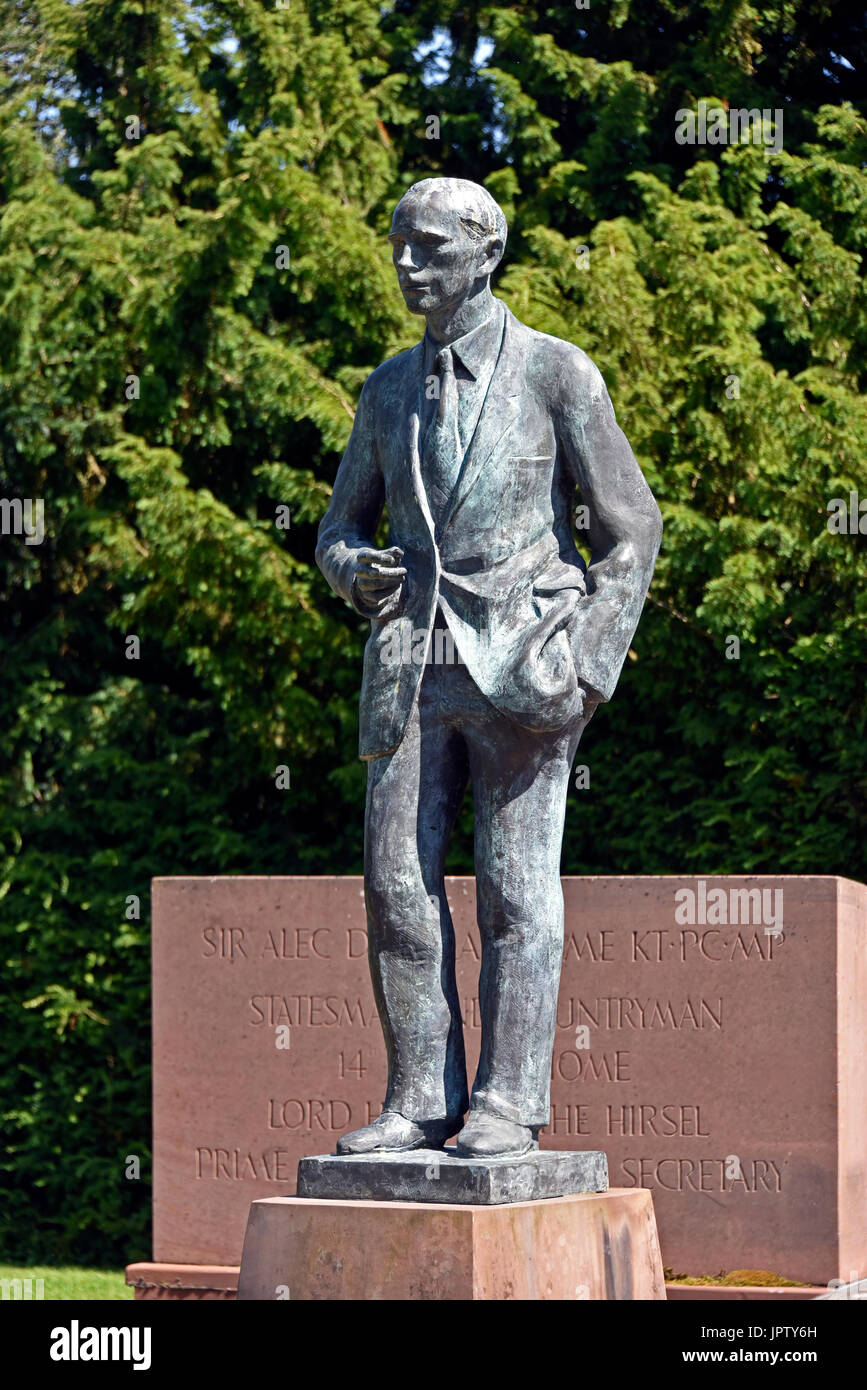
Britain's new prime minister Sir Alec Douglas-Home Vintage Photograph 1848278
Table of Content
As Lord Dunglass, the courtesy title he held until he succeeded in 1951 to the earldom of Home, he sat in the House of Commons as a Unionist (1931–45, 1950–51). During his tenure of public service, Home became known for his command over dealing with foreign matters. Interestingly, Home initially had no interest in venturing into politics.

He was encased in plaster and kept flat on his back for most of that period. Although buoyed up by the sensitive support of his wife and family, as he later confessed, "I often felt that I would be better dead". Towards the end of 1942 he was released from his plaster jacket and fitted with a spinal brace, and in early 1943 he was mobile for the first time since the operation. During his incapacity he read voraciously; among the works he studied were Das Kapital, and works by Engels and Lenin, biographies of nineteenth and twentieth century politicians, and novels by authors from Dostoyevsky to Koestler.
Opposition, 1964–70
R. Thorpe notes that during the passage through Parliament of the Peerage Act 1963, the draft legislation originally provided that a disclaimed peerage would lapse permanently, rather than merely for the lifetime of the disclaimant. Thorpe observes that if this provision had remained a condition of disclaiming his earldom in 1963, thus preventing his son from inheriting the title in due course, Home would not have gone ahead and would not have become prime minister. In negotiations on the future of Rhodesia Douglas-Home was less successful. He was instrumental in persuading the rebel leader, Ian Smith, to accept proposals for a transition to African majority rule.
In most respects, when Home took up the appointment it seemed to be a relatively uneventful period in the history of the Commonwealth. The upheaval of Indian independence in 1947 was well in the past, and the wave of decolonising of the 1960s was yet to come. However, it fell to Home to maintain Commonwealth unity during the Suez Crisis in 1956, described by Dutton as "the most divisive in its history to date".
Foreign and Commonwealth Office, 1970–74
At the time, the Conservative Party had no formal procedure for selecting a leader, merely a series of informal soundings among MPs and senior party figures. Queen Elizabeth II was expected to choose a new Prime Minister on the basis of advice given her by the party's elder statesmen. In 1962, he was created a knight of the Order of the Thistle, the highest Scottish honour and in the personal gift of the Monarch, which entitled him to be styled "Sir" after later renouncing his earldom. The term of the Parliament elected in 1959 was due to expire in October 1964. Parliament was dissolved on 25 September and after three weeks of campaigning the general election took place on 15 October. The Conservatives under Douglas-Home did much better than widely predicted, but Labour under Wilson won with a narrow majority.
However, if they intended to export their views to other parts of the world, Home intended to stand against it. Sir Alec Douglas-Home and his wife Elizabeth arrive at Church House, Westminster, London, for the election of the new Conservative Party leader, 11th... But Mr Reginald Maudling regarded as one of the main contenders for the leadership of the Conservative... Alec Douglas-Home , Lord Dunglass, the parliamentary aide to Neville Chamberlain, and Sir Archibald Sinclair , arrive at 10 Downing Street following... Press Conference held by Prime Minister Edward Heath at the Conservative Party Head Office in Smith Square ahead of the General Election. Estimated delivery dates - opens in a new window or tab include seller's handling time, origin ZIP Code, destination ZIP Code and time of acceptance and will depend on shipping service selected and receipt of cleared payment.
Douglas-Home's cabinet, October 1963 – October 1964
In east–west relations, Douglas-Home continued his policy of keeping the Soviet Union at bay. The Wilson administration had merged the Colonial Office and the Commonwealth Relations Office in 1966 into the Commonwealth Office, which, two years later, was merged with the Foreign Office, to form the Foreign and Commonwealth Office . This time, both ministers were in the Commons; Barber's cabinet post was officially Chancellor of the Duchy of Lancaster. Heath invited Douglas-Home to join the cabinet, taking charge of Foreign and Commonwealth Affairs. In earlier centuries it had not been exceptional for a former prime minister to serve in the cabinet of a successor, and even in the previous fifty years Arthur Balfour, Stanley Baldwin, Ramsay MacDonald and Neville Chamberlain had done so. As of 2021, Douglas-Home is the last former premier to have served under a successor.

Nevertheless, Macmillan advised the Queen that he considered Home the right choice. Little of this was known beyond the senior ranks of the party and the royal secretariat. On 18 October The Times ran the headline, "The Queen May Send for Mr. Butler Today". The Daily Telegraph and The Financial Times also predicted that Butler was about to be appointed. Aware of the divisions within the governing party, she did not appoint him Prime Minister, but invited him to see whether he was able to form a government. In 1963, therefore, it was well established that the Prime Minister must be a member of the House of Commons.
Stuart, previously an influential chief whip, was a confidant of Churchill, and possibly the most powerful Scottish Secretary in any government. Thorpe writes that Home owed his appointment to Stuart's advocacy rather than to any great enthusiasm on the Prime Minister's part (Churchill referred to him as "Home sweet Home"). In addition to his ministerial position Home was appointed to membership of the Privy Council , an honour granted only selectively to ministers below cabinet rank. Dunglass succeeded him, inheriting the title of Earl of Home together with the extensive family estates, including the Hirsel, the Douglas-Homes' principal residence. The new Lord Home took his seat in the Lords; a by-election was called to appoint a new MP for Lanark, but it was still pending when Attlee called another general election in October 1951. The Unionists held Lanark, and the national result gave the Conservatives under Churchill a small but working majority of seventeen.
Home resigned in 1965 and served at the ‘Foreign and Commonwealth Office’ (1970–1974). Home had learned a great deal in his years close to prime ministers, especially with regard to foreign policy. In 1955, he became secretary of state for Commonwealth relations in Anthony Eden's government. Though the post was a minor one, Home was noticed when Eden fumbled in the Suez crisis of 1956. With regard to the question of Rhodesian independence, Home advocated a multiracial government, but was unable to convince the white minority government.
Heath was widely seen as ineffective against Wilson, and as the 1970 general election approached there was concern within the party that he would lose, and that Powell would seek to replace him as leader. Maudling and the chief whip, William Whitelaw, believed that if Heath had to resign Douglas-Home would be the safest candidate to keep Powell out. Douglas-Home shared their view that Labour would win the 1970 election, and that Heath might then have to resign, but he declined to commit himself. To the surprise of almost everyone except Heath, the Conservatives won the election, with a majority of 31 seats. It was assumed in the Times article, and by other commentators, that if Hailsham was a candidate he would have to renounce his peerage. The last British Prime Minister to sit in the House of Lords was the third Marquess of Salisbury in 1902.
By 1923, having to choose between Baldwin and Lord Curzon, George V decided that "the requirements of the present times" obliged him to appoint a Prime Minister from the Commons. His private secretary recorded that the King "believed he would not be fulfilling his trust were he now to make his selection of Prime Minister from the House of Lords". In 1963, therefore, it was well established that the Prime Minister should be a member of the House of Commons. On 10 October Hailsham announced his intention to renounce his viscountcy.The "customary processes" once again took place. The usual privacy of the consultations was made impossible because they took place during the party conference, and the potential successors made their bids very publicly. Butler had the advantage of giving the party leader's keynote address to the conference in Macmillan's absence, but was widely thought to have wasted the opportunity by delivering an uninspiring speech.
The opposition retreated, with a statement in the press that "The Labour Party is not interested in the fact that the new Prime Minister inherited a fourteenth Earldom – he cannot help his antecedents any more than the rest of us." Having ruled himself out of the race when the news of Macmillan's illness broke, Home angered at least two of his cabinet colleagues by changing his mind. Macmillan quickly came to the view that Home would be the best choice as his successor, and gave him valuable behind-the-scenes backing. He let it be known that if he recovered he would be willing to serve as a member of a Home cabinet. Butler, by contrast, was seen as on the liberal wing of the Conservatives, and his election as leader might split the party.
He learned, in intimate detail, how the British political system worked. He learned that Britain could not negotiate as long as it had a weak military. Home realized that Britain could not win a war without a strong military and support from the French and Americans.
Macmillan's government
Douglas-Home set up an independent commission chaired by a senior British judge, Lord Pearce, to investigate how acceptable the proposals were to majority opinion in Rhodesia. Home was generally warmly regarded by colleagues and opponents alike, and there were few politicians who did not respond well to him. One was Attlee, but as their political primes did not overlap this was of minor consequence. Their spheres of influence overlapped in the Central African Federation.


Comments
Post a Comment